


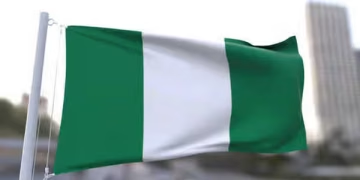


As international aid for education, culture, and science continues to decline at an alarming rate, the United Nations Educational, Scientific and Cultural Organization (UNESCO) has issued a strong call for renewed global commitment. During the International Conference on Financing for Development held on July 3, 2025, in Seville, Spain, UNESCO welcomed a joint declaration in which member states reaffirmed their support for financing education, culture, and scientific cooperation as pillars of global development and stability.
UNESCO Director-General Audrey Azoulay emphasized that education, culture, and science are not luxuries but essentials. “With every dollar invested in education generating GDP growth of $15–20, failing to fund these sectors undermines not only national economies but our shared future,” Azoulay stated. Yet, despite this evidence, funding for these sectors has been slashed. A new analysis from the UNESCO Global Education Monitoring Report reveals that aid to education could fall by over 25% between 2023 and 2027, with a 12% drop already recorded in 2024.
This is particularly worrying for low-income countries where foreign education aid constitutes about 17% of public education budgets and in some cases, even up to half. Africa is hit the hardest. UNESCO’s latest figures show that 272 million children and youth are currently out of school globally, and over 50% of them live in Africa. Nigeria alone contributes over 10.5 million to that number, according to UNICEF (2024), making it the country with the highest number of out-of-school children worldwide.
UNESCO is not just raising the alarm, it is proposing innovative solutions. One such idea is debt-for-education swaps, where debt owed to foreign governments is redirected toward domestic education investments. Past successes include partnerships between Germany and Indonesia (2002–2011) and Côte d’Ivoire and France (2023). In line with a joint 2024 initiative between Azoulay and Brazilian President Lula da Silva, UNESCO is now working on a global roadmap to expand these mechanisms to more countries.
The crisis in education funding is mirrored in the cultural and scientific domains. The cultural and creative industries contributed 3.1% to global GDP in 2022 and created nearly 50 million jobs. Despite this, funding for culture remains sparse. Yet projects in Iraq, Yemen, and the Caribbean demonstrate that cultural investments can transform fragile economies. In Iraq’s Mosul, over 5,000 jobs were created through heritage reconstruction. In the Caribbean, UNESCO’s Transcultura Programme has supported over 2,500 creatives across 17 countries.
In Nigeria, the cultural sector remains underfunded, despite having vast potential in Nollywood, music, literature, and art. According to the National Bureau of Statistics (NBS), the Nigerian entertainment and media industry grew by 6.4% in 2024, yet public investment in cultural infrastructure remains less than 0.5% of the federal budget. UNESCO urges Nigerian policymakers to mainstream culture into development frameworks, especially with the upcoming MONDIACULT 2025 conference in Barcelona.
In science, the situation is similarly bleak. 80% of countries spend less than 1% of their GDP on research and development, according to the 2025 UNESCO Science Report. Even more concerning, ocean sciences vital for climate and biodiversity receive just 1.7% of national research budgets globally. These figures are untenable, especially as Africa, including Nigeria, grapples with climate change, food insecurity, and public health crises.
Beyond funding, UNESCO advocates for open science sharing data, infrastructure, and knowledge across borders. The 2021 UNESCO Recommendation on Open Science encourages integration of indigenous knowledge and citizen science into mainstream research. This would benefit countries like Nigeria, where local innovation in areas such as agriculture, medicine, and environmental conservation often goes undocumented and underfunded.
UNESCO further emphasized that political will is key. While financial constraints are real, the refusal to invest in these sectors is often political rather than purely economic. The Paris-based organization argues that nations must rethink their national priorities and global solidarity mechanisms. For example, many African countries, including Nigeria, spend more on debt servicing than on education. In 2022, total African debt servicing matched the entire public education budgets for the continent.
For Nigeria, UNESCO’s call is particularly urgent. The country’s education sector receives less than 8% of the national budget, far below the UNESCO-recommended benchmark of 15–20%. Culture and science fare even worse, receiving under 1% combined. Without significant domestic reallocation and innovative financing from international partnerships, the vision of transforming Nigeria into a knowledge economy will remain out of reach.
The joint declaration from the Seville conference marks a step forward but action must follow. UNESCO is encouraging all 194 member states to systematize the integration of education, culture, and science into their sustainable development goals and national budgets. This requires not just rhetoric but enforceable commitments, regular audits, and multilateral cooperation.
UNESCO’s efforts are backed by a network of over 2,300 staff across 54 country offices, managing 13,000+ partner schools, 2,000+ biosphere reserves and heritage sites, and city-based innovation networks. Nigeria, with its rich cultural diversity, growing youth population, and increasing regional influence, stands to benefit immensely if it chooses to act.
As the world shifts toward more polarized politics and economic uncertainty, UNESCO’s message is both a warning and a roadmap. “If wars begin in the minds of men,” the UNESCO Constitution reminds us, “then peace and progress must also be constructed there.” The future of Nigeria’s youth, its culture, and its innovation depends on how seriously that construction is funded today.


