


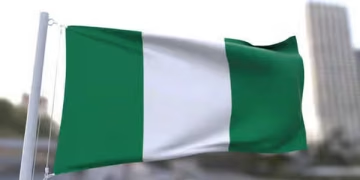


The University of Ibadan (UI) is Nigeria’s first and oldest university, established in 1948 as a college of the University of London before gaining full autonomy. Located in Ibadan, Oyo State, the institution has grown to become a symbol of academic heritage and excellence in Africa. Its motto, “Recte Sapere Fons” (To think straight is the fount of knowledge), continues to guide its intellectual pursuits. As a Federal Government-owned university, UI has remained at the forefront of higher education in Nigeria for decades.
Today, the University of Ibadan is home to over 16 faculties, including Medicine, Pharmacy, Law, Engineering, Agriculture, Veterinary Medicine, Arts, Social Sciences, Education, and Technology. With a combined undergraduate and postgraduate population of more than 35,000 students, the university boasts both size and influence, making it one of the most comprehensive academic institutions in Africa.
Its main campus in Ibadan is equipped with modern teaching and research facilities, while its University College Hospital (UCH) is regarded as one of the best teaching hospitals in Africa. These facilities support both academic learning and groundbreaking medical research, strengthening the university’s global reputation.
UI consistently ranks as Nigeria’s number one university in most local and global rankings, a position it has maintained due to its strong academic culture, commitment to research, and international collaborations. Its postgraduate program is particularly well-regarded, with a wide range of research opportunities across disciplines.
Beyond academics, the University of Ibadan has made immense cultural and intellectual contributions to Nigeria. It is a hub for literature, arts, and social thought, producing some of the most prominent voices in African scholarship, writing, and activism. Its legacy in shaping Nigeria’s academic elite cannot be overstated.
Famous Alumni of the University of Ibadan
Over the years, UI has produced an impressive roster of alumni who have made global impact in politics, literature, academia, business, and public service.
- Wole Soyinka – Nobel Laureate in Literature and the first African Nobel Prize winner.
- Chinua Achebe – Legendary novelist, best known for Things Fall Apart.
- Ken Saro-Wiwa – Renowned writer, activist, and environmentalist.
- Emeka Anyaoku – Former Secretary-General of the Commonwealth of Nations.
- Bola Ige – Former Attorney General of Nigeria.
- Jubril Aminu – Distinguished academic, politician, and diplomat.
- Grace Alele-Williams – First female Vice-Chancellor in Nigeria.
- William Kumuyi – Founder of Deeper Life Bible Church.
- Kayode Fayemi – Former Governor of Ekiti State.
- Akinwumi Adesina – President of the African Development Bank (AfDB).
- Olusegun Mimiko – Former Governor of Ondo State.
- Bayo Ohu – Veteran journalist with The Guardian.
- John Pepper Clark (JP Clark) – Iconic poet and playwright.
- Femi Osofisan – Playwright and distinguished professor.
- Professor Olikoye Ransome-Kuti – Former Minister of Health, brother to Fela Kuti.
This distinguished alumni list highlights the university’s role as a training ground for individuals who continue to shape Nigeria, Africa, and the world.
The Enduring Legacy of the University of Ibadan
As Nigeria’s first university, the University of Ibadan enjoys unmatched heritage and prestige, symbolizing academic authority and respect across the country. Its reputation as a world-class institution is further reinforced by its consistent ranking as Nigeria’s number one university and one of the most respected in Africa.
UI’s literary and intellectual legacy is evident in its production of globally renowned writers, thinkers, and activists whose works continue to influence generations. Beyond the arts, the institution is also recognized for its strong research base, particularly in medicine, agriculture, social sciences, and the humanities, areas in which it continues to drive innovation and knowledge.
The alumni of the University of Ibadan form one of the most influential networks in Africa, ranging from Nobel Laureates to political leaders and captains of industry. This distinguished body of graduates underscores the university’s position as a benchmark of academic brilliance and a symbol of excellence for Nigeria and beyond.
The University of Ibadan is therefore more than just an academic institution; it is a national legacy. Its history, achievements, and contributions to knowledge continue to make it a beacon for Africa and a critical pillar in the global academic community.


